Essay 01 · Economics
Who Keeps the Savings When Lawyers Use AI?
A lower fee, a stronger contribution model, and a bank account with a follow-up question.
Watch the one-minute companion exercise
Watch the complete narrated film (10:35)
· 9 min read
Fictional teaching example. No measured Talden product-performance result.
Imagine cutting a client’s legal fee from $50,000 to $40,000 while improving your firm’s modeled contribution.
The client would probably take the meeting. Finance should come too.
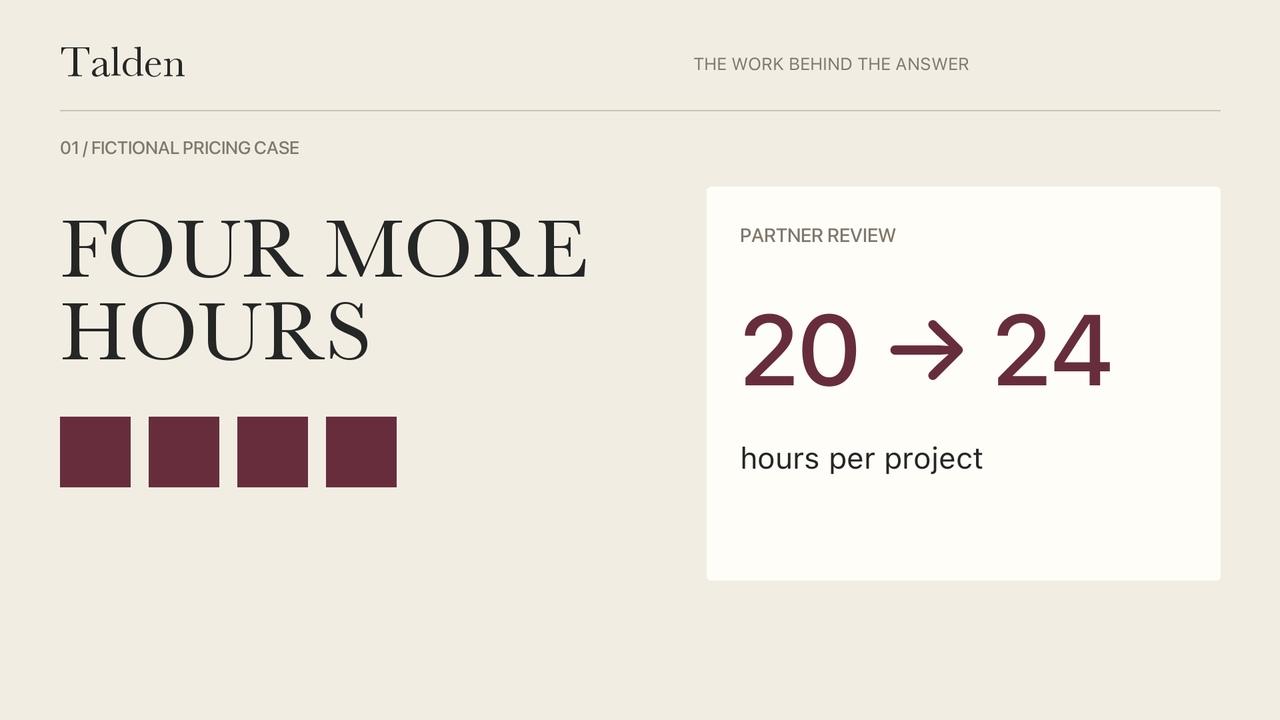
In the hypothetical below, that offer saves clients $200,000 a year and improves the firm’s annual contribution by $50,000. It looks like a promising bargain. Then we discover that four extra partner hours per project would consume almost the entire improvement.
And the bank account has a follow-up question.
The useful AI pricing discussion begins here: with the complete service, the people needed to deliver it, and the money that actually moves. These figures are teaching assumptions, not reported results from Talden or another product.
First, finish the assignment
Our firm completes 20 comparable commercial-contract projects each year. Each involves reviewing a defined batch of agreements, identifying departures from the client’s business brief, obtaining included specialist advice, resolving ordinary questions, and completing agreed revisions and advice.
Continuing monitoring or a new transaction falls outside that scope.
The current fee is $50,000 per project. The firm collects every fee. Assigned delivery resources cost $35,000 per project.
Annual revenue: $1 million. Assigned delivery cost: $700,000. Contribution: $300,000.
Now suppose a tested AI workflow completes the same service to the same acceptable standard for $20,000 per project, including usage charges. Allow another $50,000 a year for implementation, training, security work, and maintenance outside those project costs.
At the proposed $40,000 fee, the calculation is: $800,000 revenue − $400,000 project costs − $50,000 program allowance = $350,000 contribution.
Clients collectively save $200,000. The firm’s contribution rises $50,000, or about 16.7 percent.
Here, “contribution” means revenue less the specified delivery resources and program allowance, before common overhead, financing, taxes, and other excluded costs. It is an economic comparison using assigned resource values. Cash available for distribution requires a separate calculation.
The cost assumptions are inspectable. Use internal hourly resource values of $600 for a partner, $350 for an associate, and $125 for support. These are illustrative costing inputs, not billing rates, salary claims, or market benchmarks; excluded common overhead also stays out of the hourly values.
The original project takes 25 partner hours, 50 associate hours, and 20 support hours: $35,000. The revised project takes 20, 20, and five hours respectively: $19,625. Add $375 of matter-specific technology usage to reach $20,000. The annual program allowance is additional.
Those revised hours must reach completion. Include verification, correction, client discussion, and ordinary exceptions. If the impressive draft leaves a partner to reconstruct the analysis or makes the client’s team perform work the firm previously handled, count that work where it lands.
Before pricing from this model, I would compare completed assignments against the same business brief. Record material omissions, corrections, client rework, and whether the advice arrived in time to inform the decision. Include difficult matters. An issue nobody found cannot be booked as an efficiency.
The four hours that change the offer
Allocate the annual program allowance across the 20 projects. The firm’s improvement is now $2,500 per project.
Four additional partner hours cost $2,400 at our assigned rate.
If those hours become normal, the annual improvement falls from $50,000 to $2,000.
The software demonstration may have ended before the most important measurement began.
That is why I would watch senior review time closely. A faster first draft can be valuable. Its economic effect depends on the rest of the assignment, especially the work it creates or removes for the person whose attention is hardest to replace.
The model creates room for a bargain
Return to the original revised-workflow assumption: 20 partner hours per project. Keep the old $50,000 fee, and annual contribution becomes $550,000. The workflow has created $250,000 of modeled improvement over the original $300,000 contribution.
Our $40,000 offer gives clients $200,000 of that gain and leaves $50,000 with the firm: an 80/20 division. The selected price produces that split. No ethical formula or universal pricing recommendation does.
At $37,500, the firm would preserve its original $300,000 contribution across 20 projects. Prices above $37,500 and below $50,000 therefore offer room for both sides to improve on this particular comparison.
Those boundaries are references. They establish neither a proper minimum fee nor what the client will pay. Common overhead remains excluded, and preserving the firm’s old contribution is a commercial objective, not a client obligation.
Suppose a competitor offers $35,000.
Read what the quote buys. An initial review that excludes the specialist issue may leave the client with another fee, coordination work, and delay. Conversely, our fuller package may contain work this client can handle internally or does not need.
“You are paying for judgment” becomes persuasive when the proposal identifies who will resolve the difficult question, which review is included, when the assignment ends, and how ordinary exceptions are handled.
If the competing $35,000 offer supplies equivalent service, timing, and reliability, our internal spreadsheet cannot make $40,000 attractive by itself. At $35,000, our firm would produce $250,000 of contribution. It needs to evaluate its actual alternatives, adjust delivery costs, change the offer, or decline the work.
Predictable committed volume and complete, organized client inputs may improve the bargain by changing real cost or uncertainty. A hoped-for pipeline deserves a different place in the forecast from work the firm can staff and collect.
An hour saved still needs a destination
Now ask finance’s question: what happens to the released hours?
If the associate remains on the same salary, finishing an assignment sooner does not itself reduce payroll. The resource model values newly available capacity. Turning that capacity into cash requires something else to happen.
Use a deliberately stark cash version. Existing salaries and other cash expenditures stay unchanged.
Released time generates no additional collections. The entire $50,000 program allowance and every $375 usage charge are new cash payments.
Collections fall $200,000. New cash payments total $57,500. The annual cash change is therefore negative $257,500, before financing or tax effects.
That can coexist with the $50,000 improvement in resource contribution. Assigned staff resources fall from $700,000 to $392,500 across the 20 projects. The 1,000 released hours carry $307,500 of assigned value. Subtract the $307,500 assigned value that has not become cash from the $50,000 modeled improvement, and the cash difference is explained.
The hours may still be valuable. They can support additional collected work, avoid a planned hire or outside expense, improve service, develop people, or make working life more sustainable. Those benefits deserve accurate names and credible plans.
The same hour cannot pay three bills. Count it once: as avoided expenditure, productive capacity, or time deliberately given back. Trace the proposed benefit to its use.
Also check when money moves. Training and implementation may need payment before the first repriced matter is collected. Attractive annual economics can still require transition funding.
Count the hours that constrain the practice
Our original 20 projects consume 1,900 hours: 500 partner, 1,000 associate, and 400 support. The revised projects consume 900: 400, 400, and 100.
Total hours fall about 52.6 percent. Partner hours fall 20 percent.
If qualified partner attention limits the practice, the second figure governs the next capacity question.
Assume 500 partner hours are available for these projects after training, implementation, management, and other demands. Assume associate and support capacity can accommodate the work. At 20 partner hours each, the firm can complete 25 comparable projects.
If it wins, completes, and collects all 25 at $40,000, revenue returns to $1 million. Subtract $500,000 of project costs and $50,000 for the program. Contribution becomes $450,000.
A 20 percent price reduction requires 25 percent more volume to preserve revenue. The capacity assumption permits those five projects; the sales plan must supply them. An annual hours total also does not guarantee that the right partner will be available when deadlines collide.
The cash version still matters. Keep existing compensation and other payments unchanged, assume no extra staffing cost, and collect all 25 fees. Revenue is restored, but the new $50,000 program payment and $9,375 of usage payments leave cash $59,375 below the original practice.
A fee of $42,375 at that volume would preserve the original cash position under these assumptions.
It is still 15.25 percent below the old price, provided clients will buy 25 projects at that fee.
Now bring back the four extra partner hours. At 24 hours per project, 500 hours accommodate only 20 whole projects. The omitted review has consumed almost all the original contribution improvement and removed capacity for the five additional matters.
One operational assumption has changed the price cushion and the growth plan.
Give the agreement the same care as the arithmetic
This example assumes a prospectively agreed fixed fee for specified completed services. An existing hourly engagement works differently.
ABA Formal Opinion 512 says hourly billing must reflect time actually spent, including appropriate AI use and review; lawyers cannot add hypothetical hours the technology saved. The advisory opinion also explains that efficiency can affect the reasonableness of an unchanged flat fee. [1]
The jurisdiction matters. ABA Model Rule 1.5 prohibits unreasonable fees. California Rule 1.5 prohibits unconscionable or illegal fees and ordinarily assesses unconscionability from the circumstances when the agreement was made, subject to its qualification for contemplated later events. California expressly recognizes flat fees for described services regardless of the amount of work ultimately involved. These are different texts. The ABA model is not binding nationwide, and neither inquiry reduces to a stopwatch. [2] [3]
Florida’s advisory Opinion 24-1 identifies alternative fee structures as a way to share efficiency benefits. That supports discussing a better agreement while leaving the actual fee subject to applicable rules. [4]
A fixed fee can provide certainty for the client and reward good organization. It also allocates delivery risk. Underestimating ordinary review does not automatically turn promised work into an extra.
Define the document set, advice, revisions, completion point, and circumstances requiring a new assignment. If uncertainty prevents responsible pricing, a defined assessment phase may be the useful first purchase.
California’s advisory Opinion 2026-210 discusses refunds of unearned advances when an engagement ends incomplete and concludes that a midstream increase in the flat fee requires Rule 1.8.1 safeguards. Those include fair and reasonable terms, written disclosure of terms and the lawyer’s role, independent representation or written advice and a reasonable opportunity to seek it, and informed written consent. Distinguish repricing already-promised work from agreeing on new services. [5] [3]
Our technology costs are included in the firm’s model. A separate client expense charge needs its own engagement and rules analysis. Florida’s opinion cautions against duplicating charges or charging costs already included in overhead. [4]
Before offering the discount
I would want a short decision record answering five questions:
- What completed service are we promising, including review and normal exceptions?
- What does it consume by role, through completion, at an acceptable standard?
- Which benefits become cash, useful capacity, or another identified improvement, and who will make that happen?
- Which person or resource constrains volume, and is there collectible demand for the capacity released?
- What does the client receive compared with its alternatives, and does the proposed fee agreement support that bargain?
For a concrete starting point, Talden’s public demonstration page provides fictional commercial-review inputs: a business brief, vendor agreement, and data terms. They can help define the work to be completed before measuring a workflow. They establish no savings result. [6]
The attractive possibility is real enough to investigate: a client can pay less while a firm benefits from better-organized work.
But the hours are only the beginning of the bargain. Follow them all the way to the client, the reviewer, and the bank account.
Sources and notes
- ABA Formal Opinion 512, Generative Artificial Intelligence Tools (July 29, 2024), pp. 12–13. Advisory discussion of fees and expenses, including actual hourly time and the effect of efficiency on flat-fee reasonableness.
- ABA Model Rule of Professional Conduct 1.5, Fees, paragraph (a). The model rule’s reasonableness standard; applicable jurisdictional rules must be determined separately.
- California Rules of Professional Conduct, Rules 1.5(a), (b) and (e), 1.8.1, and 1.16(e)(2). Fees, the rule’s agreement-timing qualification, flat-fee definition, specified client-transaction safeguards, and return of unearned advances.
- The Florida Bar, Ethics Opinion 24-1 (January 19, 2024), pp. 5–6. Advisory discussion of alternative fee structures, overhead already included in charges, and duplicate billing.
- State Bar of California, Formal Opinion 2026-210, Flat Fees and Termination, pp. 1–3 and 6–9. Advisory analysis of incomplete flat-fee engagements, unearned advances, and midstream fee increases under Rule 1.8.1.
- Talden, public demonstration materials. Fictional commercial-review inputs: business brief, vendor agreement and data terms. The page distinguishes inputs from recorded runs and reviewed outputs to be added later. Accessed October 19, 2026.
Watch the one-minute exercise
Silent · 60 seconds
Four More Partner Hours Can Change an AI Pricing Offer
A fictional teaching exercise. All information is presented visually; there is no spoken audio.
Read the full video transcript
[00–07 seconds]
TALDEN
Fictional resource model
THE WORK BEHIND THE ANSWER
THE PRICING DECISION
20
partner hours per project
Now make that 24.
Four hours can change
the pricing decision.

[07–18 seconds]
TALDEN
Fictional resource model
THE WORK BEHIND THE ANSWER
THE STARTING ASSUMPTION
$50,000
Modeled annual
contribution improvement
Across 20 projects.

Assumes 20 partner hours
per project.
Resource model.
Not a cash saving or
a measured product result.

[18–30 seconds]
TALDEN
Fictional resource model
THE WORK BEHIND THE ANSWER
FOUR EXTRA HOURS
4 extra partner hours
per project
× $600 assumed cost per hour

× 20 projects
$48,000
Added annual
resource cost

[30–40 seconds]
TALDEN
Fictional resource model
THE WORK BEHIND THE ANSWER
THE CUSHION CHANGES
$50,000
− $48,000
$2,000
Modeled annual
contribution improvement
The same 20 projects.

[40–52 seconds]
TALDEN
Fictional resource model
THE WORK BEHIND THE ANSWER
THE CALENDAR CHANGES, TOO
500 available
partner hours
At 20 hours per project
25 whole projects
At 24 hours per project
20 whole projects
Capacity is not the same
as cash savings.

[52–60 seconds]
TALDEN
Fictional resource model
THE WORK BEHIND THE ANSWER
BEFORE PRICING A FASTER DRAFT
Measure the
senior work
needed to finish
the assignment.
Four hours can be the difference
between an attractive offer
and a very thin cushion.
Download video (MP4)Text transcriptWatch on YouTube
Designed fictional exhibits, not recorded Talden outputs or measured product results.
Watch the complete film
Complete narrated film · 10:35
AI and Legal Fees: Four Hours That Change the Answer
By Billy Dentino. Synthetic narration with prepared fictional exhibits; not Billy’s recorded voice or a Talden product run.
Chapters and full transcript
- 0:00 Would you cut the fee?
- 0:20 Twenty completed projects.
- 0:43 Price the complete workflow.
- 1:10 The apparently generous bargain.
- 1:52 What counts as finished?
- 2:23 Measure the work through completion.
- 2:51 Now open the bank account.
- 3:18 A different cash answer.
- 3:39 Time value is not a payroll payment.
- 3:56 Choose where the hour goes.
- 4:22 Follow the senior constraint.
- 4:38 Capacity has an owner.
- 4:59 Capacity still needs clients.
- 5:22 Restored revenue leaves another question.
- 5:42 Change one input.
- 5:51 Four hours consume the cushion.
- 6:11 The five extra projects disappear.
- 6:32 A price chooses how to share value.
- 7:09 A reference point, not a market price.
- 7:28 The competing offer.
- 7:52 What can actually be staffed and collected?
- 8:08 Match the agreement to the work.
- 8:31 Local rules matter.
- 9:03 Define what is included and earned.
- 9:44 Before the next pricing conversation.
- 10:04 Saved time needs somewhere to go.
AI and Legal Fees: Four Hours That Change the Answer

By Billy Dentino, retired attorney and founder of Talden Inc.
Synthetic narration with prepared fictional exhibits; not Billy’s recorded voice or a Talden product run.

[00:00:00] Would you cut the fee?

Would you cut a fifty-thousand-dollar legal fee to forty thousand? In this fictional practice, the firm can charge less and improve its modeled contribution. Then four extra partner hours nearly erase the gain. Before we price the faster draft, let’s find out what it takes to finish the work.

[00:00:20] Twenty completed projects.

Here is the original practice: twenty comparable projects a year, every fifty-thousand-dollar fee collected. Revenue is one million dollars. Each completed project consumes thirty-five thousand dollars of assigned staff resources. That leaves three hundred thousand dollars of contribution.

[00:00:43] Price the complete workflow.

Now suppose a tested AI workflow can complete the same defined service, at the same acceptable quality, for twenty thousand dollars per project. That includes three hundred and seventy-five dollars of technology usage. Allow another fifty thousand a year for implementation, training, security work, and maintenance not already counted.

[00:01:10] The apparently generous bargain.

Charge forty thousand. Eight hundred thousand comes in. Four hundred thousand goes against project resources and usage; fifty thousand against the program. Contribution is three hundred and fifty thousand. Clients receive a twenty percent fee cut. The firm’s contribution improves by about seventeen percent. Contribution here deducts the specified resource values and program allowance, before common overhead, financing, taxes, and other excluded costs. It does not establish net profit or distributable cash.

[00:01:52] What counts as finished?

And “completed project” is doing work in that sentence. Our service includes the agreed commercial agreements and schedules, business-brief review, included specialist input, ordinary questions, revisions, and advice through a defined completion point. Count the checking and correction. Count the difficult exception. If the client now spends three days reconstructing the analysis, the work has found a new desk.

[00:02:23] Measure the work through completion.

The hours and internal costing values are on screen. They are assumptions, separate from billing rates and salaries. Before offering a real price, test comparable completed work against the same brief. Count missed material issues and client rework. Keep the difficult cases in the evidence. An issue nobody discovered is not an efficiency.

[00:02:51] Now open the bank account.

Now open the bank account. We saved thirty associate hours per project. Did the associate’s salary fall? In this cash version, salaries and all other existing cash spending stay unchanged. The available hours produce no extra collections. And the full fifty-thousand-dollar program allowance, plus usage, becomes new cash spending.

[00:03:18] A different cash answer.

The discount costs two hundred thousand in collections. Usage adds seven thousand five hundred in payments. The program adds fifty thousand. Cash is two hundred and fifty-seven thousand five hundred dollars worse, before financing or tax effects.

[00:03:39] Time value is not a payroll payment.

The bridge between that result and our improved contribution is three hundred and seven thousand five hundred dollars of assigned value for released staff time. In this version, none becomes a lower compensation payment.

[00:03:56] Choose where the hour goes.

Those hours may still be valuable. Use them for additional paid work, an avoided hire or external expense, better service, training, or a more sustainable working life. Name the benefit you intend. Count it once. One hour cannot be sold, removed from payroll, and given back to the lawyer simultaneously.

[00:04:22] Follow the senior constraint.

Let’s try selling more work. Across twenty projects, total time falls from one thousand nine hundred hours to nine hundred. But partner time falls only from five hundred to four hundred.

[00:04:38] Capacity has an owner.

Assume qualified partner attention is the constraint. We have five hundred partner hours available after all other demands, and enough associate and support capacity. At twenty partner hours per project, we can complete twenty-five projects.

[00:04:59] Capacity still needs clients.

Win, finish, and collect all twenty-five at forty thousand, and revenue returns to a million. Modeled contribution becomes four hundred and fifty thousand. A twenty percent price cut required twenty-five percent more volume. The spreadsheet has supplied capacity; it has not supplied clients.

[00:05:22] Restored revenue leaves another question.

Keep the earlier cash assumptions, with no added staffing expense, and cash is still fifty-nine thousand three hundred and seventy-five dollars below the old practice because of the new program and usage payments. Restoring revenue leaves another question to answer.

[00:05:42] Change one input.

Now change one input. Partner review takes twenty-four hours per project instead of twenty.

[00:05:51] Four hours consume the cushion.

Four extra hours, at our six-hundred-dollar resource value, cost twenty-four hundred dollars per project. Across the original twenty projects, that is forty-eight thousand. Our fifty-thousand-dollar contribution improvement becomes two thousand.

[00:06:11] The five extra projects disappear.

And five hundred partner hours now support only twenty whole projects. The five extra projects disappear too. Four hours have changed both the price cushion and the growth plan. Several deadlines in the same week could tighten the constraint further.

[00:06:32] A price chooses how to share value.

What, then, is the right price? Return to the original revised-workflow assumption: twenty partner hours per project. Keeping the old fifty-thousand-dollar fee produces five hundred and fifty thousand of contribution, a gain of two hundred and fifty thousand. At forty thousand, clients receive two hundred thousand of that gain and the firm retains fifty thousand. That eighty-twenty division follows from our selected price. It is no universal rule for sharing AI savings.

[00:07:09] A reference point, not a market price.

A thirty-seven-thousand-five-hundred-dollar fee preserves the original contribution at twenty projects. That is a model reference point, not a market price or assurance that overhead is covered. The client does not owe us our old contribution.

[00:07:28] The competing offer.

Suppose a competitor quotes thirty-five thousand. Compare the completed service, including specialist work, timing, revisions, and the client’s own burden. If it is equivalent, our spreadsheet cannot make forty thousand attractive by itself. Consider better delivery, different contribution, other work, or declining the assignment.

[00:07:52] What can actually be staffed and collected?

Predictable committed volume, organized inputs, or a defined assessment before fixed pricing may improve the bargain. A hoped-for pipeline deserves different treatment from work you can actually staff and collect.

[00:08:08] Match the agreement to the work.

Our example assumes a prospectively agreed fixed fee. For hourly work, ABA guidance permits billing actual time spent, including appropriate AI use and review, without adding back hours saved. Its advisory view also recognizes that efficiency can affect flat-fee reasonableness.

[00:08:31] Local rules matter.

Local rules matter. The ABA model prohibits unreasonable fees; California prohibits unconscionable or illegal fees and expressly recognizes flat fees for described services regardless of the eventual work. California generally looks to the circumstances when the agreement was made, except when the parties contemplate later events affecting the fee. Neither approach reduces the decision to a stopwatch.

[00:09:03] Define what is included and earned.

Define what the fee includes and when it is earned. California’s flat-fee advisory addresses refunds of unearned advances when work ends incomplete, and Rule one point eight point one safeguards for increasing the fee during the representation. Extra effort on included work does not automatically justify another charge. Nor does a technology cost in this model authorize an invoice surcharge. Florida’s advisory cautions against separately billing costs already included in overhead, or duplicating charges. The article contains the authorities and distinctions.

[00:09:44] Before the next pricing conversation.

Before your next pricing conversation, choose one recurring service. Measure it through completion. Reconcile the model to actual payments and collections. Put the work on the senior reviewer’s calendar. Then add four hours and see what survives.

[00:10:04] Saved time needs somewhere to go.

This film is by Billy Dentino, a retired attorney and the founder of Talden. At Talden A I dot com slash demo, you can examine fictional vendor-review inputs and a client brief. Use them to think through what a complete assignment requires before estimating its economics. The time you have saved still needs somewhere to go. A good offer gives both the client and the firm an honest answer about where.
Download film (MP4)Text transcriptEnglish captions
Fictional teaching examples, not measured Talden product results. See the companion essay for the complete discussion, sources and qualifications.
Put the questions to work
Bring the documents. Keep the judgment.
Explore Talden’s fictional matter materials, then see how its workflows fit your own work.
Explore the fictional examples
Start your free trial